Subscribe: by Email | in Reader

The Poems of our Climate -- Wallace Stevens

Guest poem sent in by Janice
(Poem #1891) The Poems of our Climate
 I

 Clear water in a brilliant bowl,
 Pink and white carnations. The light
 In the room more like a snowy air,
 Reflecting snow. A newly-fallen snow
 At the end of winter when afternoons return.
 Pink and white carnations - one desires
 So much more than that. The day itself
 Is simplified: a bowl of white,
 Cold, a cold porcelain, low and round,
 With nothing more than the carnations there.

 II

 Say even that this complete simplicity
 Stripped one of all one's torments, concealed
 The evilly compounded, vital I
 And made it fresh in a world of white,
 A world of clear water, brilliant-edged,
 Still one would want more, one would need more,
 More than a world of white and snowy scents.

 III

 There would still remain the never-resting mind,
 So that one would want to escape, come back
 To what had been so long composed.
 The imperfect is our paradise.
 Note that, in this bitterness, delight,
 Since the imperfect is so hot in us,
 Lies in flawed words and stubborn sounds.
-- Wallace Stevens
I like this poem for its seemingly flawless finish....and how the last
line quietly unravels it. The image of the bowl and carnations is a
metaphor for the poem...beautiful, delicate, perfect. Stevens manages
to take that simple picture and make it so much more...conveying that
that perfection and 'world of clear water, brilliant-edged' is not
enough, there still remains the 'never-resting mind' that longs for
escape, since (and this has to be my favourite line!) 'The imperfect
is our paradise'. It does bring connotations of the Fall in Eden (or
is that just me?!). Our delight lies then in the flawed and the
stubborn...perhaps the most vital characteristics of what makes us
human...

Janice

[And speaking of climate, Bronson Stocker has suggested a theme in tribute
to the recent heat wave that has been gripping large swathes of the world -
an excellent idea, say I. The theme will kick off on Monday - contributions
welcomed as usual. -martin]

A Modest Wit -- Selleck Osborn

       
(Poem #1890) A Modest Wit
 A supercilious nabob of the East -
 Haughty, being great - purse-proud, being rich -
 A governor, or general, at the least,
 I have forgotten which -

 Had in his family a humble youth,
 Who went from England in his patron's suit,
 An unassuming boy, in truth
 A lad of decent parts, and good repute.

 This youth had sense and spirit;
 But yet with all his sense,
 Excessive diffidence
 Obscured his merit.

 One day, at table, flushed with pride and wine,
 His Honor, proudly free, severely merry,
 Conceived it would be vastly fine
 To crack a joke upon his secretary.

 "Young man," he said, "by what art, craft, or trade,
 Did your good father gain a livelihood?" -
 "He was a saddler, sir," Modestus said,
 "And in his time was reckoned good."

 "A saddler, eh! and taught you Greek,
 Instead of teaching you to sew!
 Pray, why did not your father make
 A saddler, sir, of you?"

 Each parasite, then, as in duty bound,
 The joke applauded, and the laugh went round.
 At length Modestus, bowing low,
 Said (craving pardon, if too free he made),
 "Sir, by your leave, I fain would know
 Your father's trade!"

 "My father's trade! by heaven, that's too bad!
 My father's trade?  Why, blockhead, are you mad?
 My father, sir, did never stoop so low -
 He was a gentleman, I'd have you know."

 "Excuse the liberty I take,"
 Modestus said, with archness on his brow,
 "Pray, why did not your father make
 A gentleman of you?"
-- Selleck Osborn
I have always enjoyed "anecdotal" poems like today's - short, pointed
stories that are all the more charming for being put into verse. (Perhaps
the best example is Leigh Hunt's "The Glove and the Lions", one of the few
such to attain wide acclaim.) Today's poem, I'll admit, is not even
particularly brilliant verse, just good enough to add to rather than detract
from the story being told, and to lend the punchline a little extra fillip.

Even at their most trivial, though, I think poems like this are not only fun
but important - important because they directly address the fact that one of
the purposes of poetry is to *entertain*. This is not to turn my nose up at
any of the other roles poetry fulfils - it is just that, far more so than
with prose, pure entertainment often seems to take a back seat to art,
emotion, cleverness, or even humour (which is not precisely the same
thing as entertainment). "A Modest Wit" has nothing particulary quotable or
polished, and indeed the language has not aged too well, but it amused me
and brightened up a dull moment, and in doing that I would say that it has
fulfilled its purpose admirably.

martin

Biography:
  Selleck Osborn, American journalist and poet (1783 - 1826)

A Grievance -- J K Stephen

       
(Poem #1889) A Grievance
  After Byron

 Dear Mr. Editor: I wish to say -
 If you will not be angry at my, writing it -
 But I've been used, since childhood's happy day,
 When I have thought of something, to inditing it;
 I seldom think of things; and, by the way,
 Although this meter may not be exciting, it
 Enables one to be extremely terse,
 Which is not what one always is in verse.

 I used to know a man, - such things befall
 The observant wayfarer through Fate's domain -
 He was a man, take him for all in all,
 We shall not look upon his like again;
 I know that statement's not original;
 What statement is, since Shakespeare? or, since Cain,
 What murder?  I believe 'twas Shakespeare said it, or
 Perhaps it may have been your Fighting Editor.

 Though why an Editor should fight, or why
 A Fighter should abase himself to edit,
 Are problems far too difficult and high
 For me to solve with any sort of credit.
 Some greatly more accomplished man than I
 Must tackle them: let's say then Shakespeare said it;
 And, if he did not, Lewis Morris may
 (Or even if he did).  Some other day,

 When I have nothing pressing to impart,
 I should not mind dilating on this matter.
 I feel its import both in head and heart,
 And always did, - especially the latter.
 I could discuss it in the busy mart
 Or on the lonely housetop; hold! this chatter
 Diverts me from my purpose.  To the point:
 The time, as Hamlet said, is out of joint,

 And perhaps I was born to set it right, -
 A fact I greet with perfect equanimity.
 I do not put it down to "cursed spite,"
 I don't see any cause for cursing in it.  I
 Have always taken very great delight
 In such pursuits since first I read divinity.
 Whoever will may write a nation's songs
 As long as I'm allowed to right its wrongs.

 What's Eton but a nursery of wrong-righters,
 A mighty mother of effective men;
 A training ground for amateur reciters,
 A sharpener of the sword as of the pen;
 A factory of orators and fighters,
 A forcing-house of genius?  Now and then
 The world at large shrinks back, abashed and beaten,
 Unable to endure the glare of Eton.

 I think I said I knew a man: what then?
 I don't suppose such knowledge is forbid.
 We nearly all do, more or less, know men, -
 Or think we do; nor will a man get rid
 Of that delusion while he wields a pen.
 But who this man was, what, if aught, he did,
 Nor why I mentioned him, I do not know,
 Nor what I "wished to say" a while ago.
-- J K Stephen
Most famous poets have attracted their share of parodies, and Byron was no
exception, but seldom have I seen a parody as perfect as today's. The
language, the tone, the metre, the sentiments, the construction, are all
spot on. Moreover, the mockery is subtle enough that there are very few
places one can point to and say "Byron would not have written that", though
the cumulative effect is unmistakably parodic. All in all a superbly
impressive piece of work, even for as consistently good a parodist as Stephen.

martin

[Links]

Byron's "Don Juan", an excellent example of the style today's poem parodies:
  [broken link] http://www.sensible.it/personal/resio/donjuan/byron/

Biography:
  http://www.bartleby.com/223/0615.html

More of Stephen's work:
  http://rpo.library.utoronto.ca/poet/310.html

Who is in Charge of the Clattering Train? -- Anonymous

Guest poem submitted by Bill Whiteford:
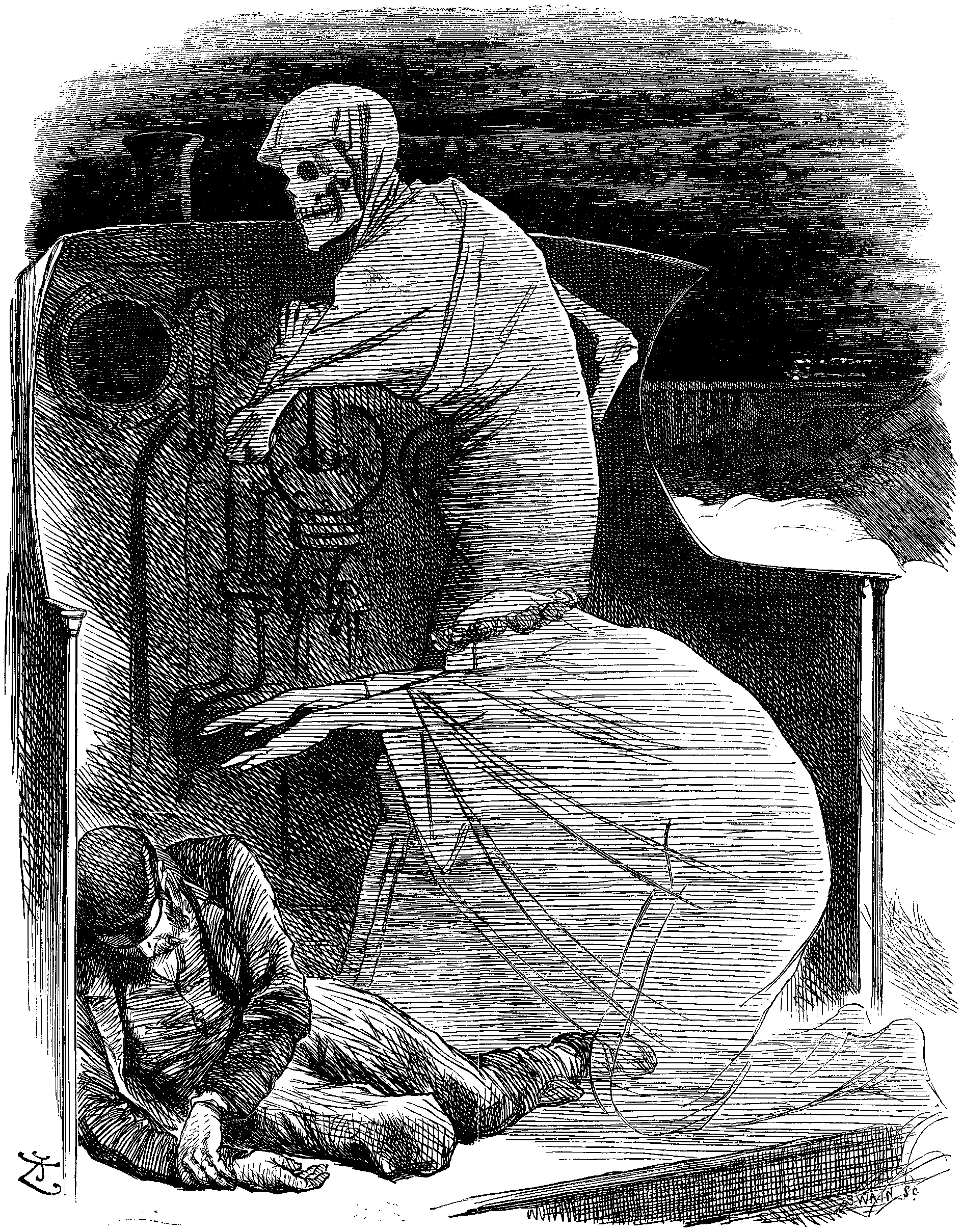
(Poem #1888) Who is in Charge of the Clattering Train?
 Who is in charge of the clattering train?
 The axles creak and the couplings strain,
 And the pace is hot, and the points are near,
 And Sleep has deadened the driver's ear;
 And the signals flash through the night in vain,
 For Death is in charge of the clattering train.
-- Anonymous
I don't know the title (though I would guess it's the whole first line).
It appears to be anonymously written. You may have heard the Churchill
character quoting this verse in the TV drama "The Gathering Storm". It
was apparently one of Winston's favourites, having been committed to
memory by him from the pages of Punch when he was about nine.

I quite like the train-like rhythm of the lines, and the way the poem
crashes into the last line. It is, of course, a kind of Victorian
melodrama in six lines. The whole thing sometimes springs to mind when,
at work, colleagues phone up and ask who is in charge.

Bill Whiteford.

[Thomas adds]

Project Gutenberg reveals that today's poem forms merely an extract --
the first two and last four lines -- of a much longer poem titled "Death
and His Brother Sleep", which appeared in Volume 99 of Punch magazine,
published October 4, 1890. The poem was attributed to "Queen Mab", and
was written in response to a rail accident at Eastleigh; it appeared in
Punch prefaced by the following lines:

  Major Marindin, in his Report to the Board of Trade
  on the railway collision at Eastleigh, attributes it
  to the engine-driver and stoker having "failed to
  keep a proper look-out." His opinion is, that both
  men were "asleep, or nearly so," owing to having
  been on duty for sixteen hours and a-half. "He
  expresses himself in very strong terms on the great
  danger to the public of working engine-drivers and
  firemen for too great a number of hours."

        -- Daily Chronicle

"Queen Mab" is also the title of a poem by Shelley, which begins:

     How wonderful is Death,
     Death, and his brother Sleep!
  One, pale as yonder waning moon
     With lips of lurid blue;
     The other, rosy as the morn
  When throned on ocean's wave
        It blushes o'er the world;
  Yet both so passing wonderful!

Clearly today's poet took both title and pseudonym from Shelley's
earlier work.

The full text of "Death and His Brother Sleep" can be found here:
  http://www.gutenberg.org/files/12306/12306-h/12306-h.htm (HTML)
  http://www.gutenberg.org/files/12306/12306.txt (plain text)
  http://www.gutenberg.org/files/12306/12306-h/images/163.png (pic)

It's interesting to note how the emphasis of the two pieces -- the
lengthy Punch original, and today's pithier (I'm tempted to say
"punchier") extract -- is completely different. Speaking for myself, I
much prefer the short version, but readers are encouraged to read them
both and make up their own minds.

Thomas.

The Lord Chancellor's Song -- W S Gilbert

       
(Poem #1887) The Lord Chancellor's Song
    Love, unrequited, robs me of my rest:
    Love, hopeless love, my ardent soul encumbers:
    Love, nightmare-like, lies heavy on my chest,
    And weaves itself into my midnight slumbers!

 When you're lying awake with a dismal headache,
   and repose is taboo'd by anxiety,
 I conceive you may use any language you choose
   to indulge in, without impropriety;
 For your brain is on fire -- the bedclothes conspire
   of usual slumber to plunder you:
 First your counterpane goes, and uncovers your toes,
   and your sheet slips demurely from under you;

 Then the blanketing tickles -- you feel like mixed pickles --
   so terribly sharp is the pricking,
 And you're hot, and you're cross, and you tumble and toss
   till there's nothing --twixt you and the ticking.
 Then the bedclothes all creep to the ground in a heap,
   and you pick 'em all up in a tangle;
 Next your pillow resigns and politely declines to remain at its usual angle!

 Well, you get some repose in the form of a doze,
   with hot eye-balls and head ever aching.
 But your slumbering teems with such horrible dreams
   that you'd very much better be waking;
 For you dream you are crossing the Channel, and tossing
   about in a steamer from Harwich --
 Which is something between a large bathing machine
   and a very small second-class carriage --

 And you're giving a treat (penny ice and cold meat)
   to a party of friends and relations --
 They're a ravenous horde -- and they all came on board
   at Sloane Square and South Kensington Stations.
 And bound on that journey you find your attorney
   (who started that morning from Devon);
 He's a bit undersized, and you don't feel surprised
   when he tells you he's only eleven.

 Well, you're driving like mad with this singular lad
   (by the by, the ship's now a four-wheeler),
 And you're playing round games, and he calls you bad names
   when you tell him that "ties pay the dealer";
 But this you can't stand, so you throw up your hand,
   and you find you're as cold as an icicle,
 In your shirt and your socks (the black silk with gold clocks),
   crossing Salisbury Plain on a bicycle:

 And he and the crew are on bicycles too --
   which they've somehow or other invested in --
 And he's telling the tars all the particulars
   of a company he's interested in --
 It's a scheme of devices, to get at low prices
   all goods from cough mixtures to cables
 (Which tickled the sailors), by treating retailers
   as though they were all vegetables --

 You get a good spadesman to plant a small tradesman
   (first take off his boots with a boot-tree),
 And his legs will take root, and his fingers will shoot,
   and they'll blossom and bud like a fruit-tree --
 From the greengrocer tree you get grapes and green pea,
   cauliflower, pineapple, and cranberries,
 While the pastrycook plant cherry brandy will grant,
   apple puffs, and three corners, and Banburys --

 The shares are a penny, and ever so many
   are taken by Rothschild and Baring,
 And just as a few are allotted to you,
   you awake with a shudder despairing --

 You're a regular wreck, with a crick in your neck, and no wonder you snore,
 for your head's on the floor, and you've needles and pins from your soles
 to your shins, and your flesh is a-creep, for your left leg's asleep, and
 you've cramp in your toes, and a fly on your nose, and some fluff in your
 lung, and a feverish tongue, and a thirst that's intense, and a general
 sense that you haven't been sleeping in clover;

 But the darkness has passed, and it's daylight at last, and the night has
 been long -- ditto, ditto my song -- and thank goodness they're both of
 them over!

 [Lord Chancellor falls exhausted on a seat.]
-- W S Gilbert
Note: From Iolanthe. I've split the (long!) lines into two; you can see the
song in its original formatting here:
  http://math.boisestate.edu/GaS/iolanthe/web_op/iol20.html

No canon of patter songs would be complete without this masterpiece of
Gilbert and Sullivan's, one of the most widely recognised of the genre, and,
to my mind, one of the finest. Gilbert was, of course, a master of carefully
crafted and logically worked out nonsense; here, he takes the license
afforded by a dreamscape and abandons even the semblance of plausibility,
shifting into a surreal (but oddly coherent) stream-of-consciousness song
that, like many of the duo's best pieces, transcends the operetta within
which it occurs.

What I really like about this song is the nigh-perfect way in which it
conveys a sense of stumbling headlong through the shifting narrative of the
dream, culminating in the breathless, helter-skelter rush of the last two
passages. This is already evident in the lyrics, but it attains its full
effect when married to Sullivan's music; the final product is both instantly
captivating and utterly memorable.

martin

[Links]

Everything Iolanthe: http://math.boisestate.edu/GaS/iolanthe/html/index.html